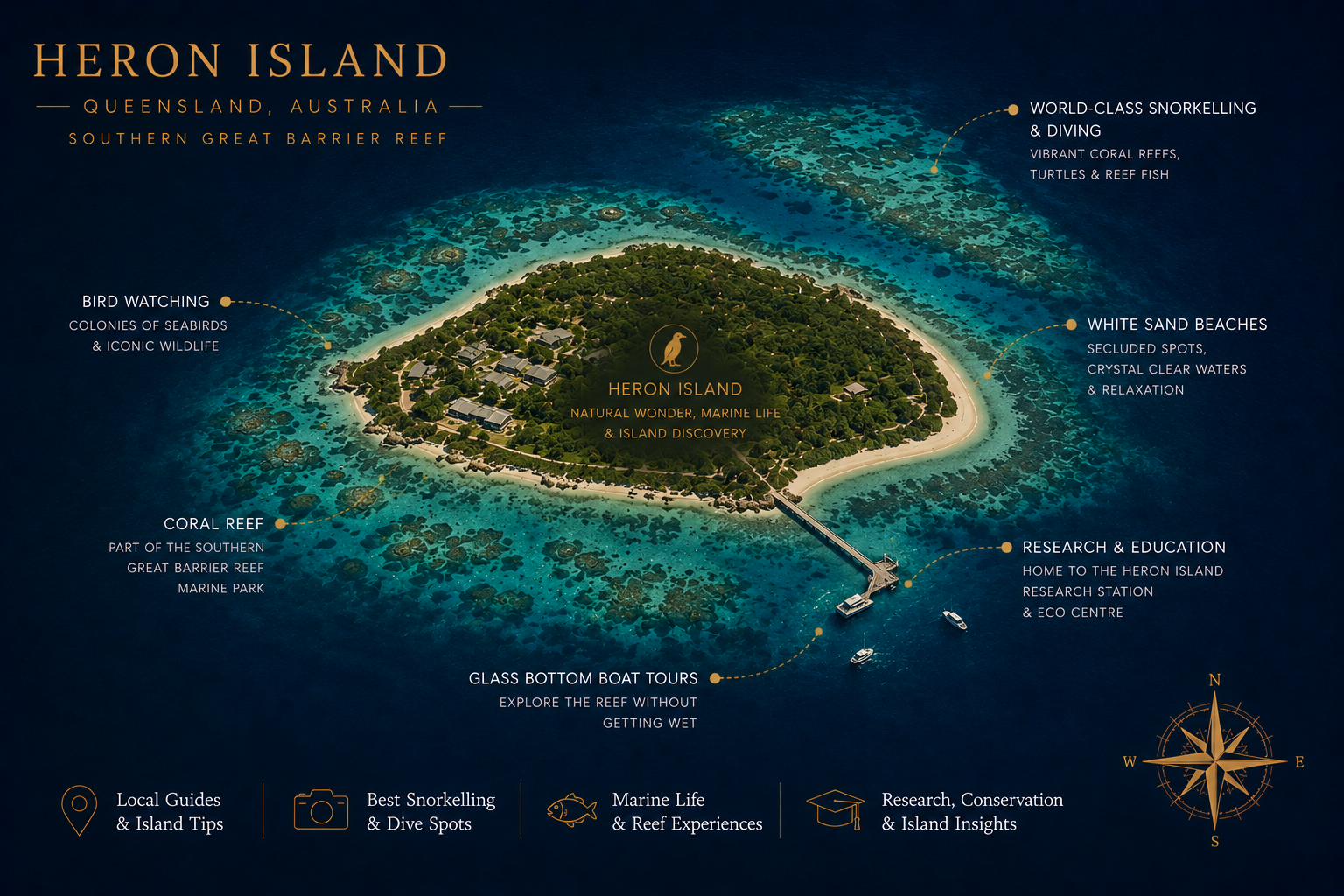
A small coral cay on the southern end of the Great Barrier Reef. The whole island is 800 metres long. There's one resort, a marine research station, and a fringing reef so close to the beach you can step off the sand and snorkel, no boat required. From November to March, sea turtles haul up the beach to nest, sometimes a metre from your bungalow.
- State
- Queensland
- State capital
- Brisbane (550 km south)
- Size
- 0.16 km² (the cay only)
- Population
- None permanent (resort + research)
- Status
- National Park & Marine Park
- Best time to visit
- Year-round; turtle nesting Nov-Mar
How to get there
Fly to Gladstone (regular flights from Brisbane, Sydney). From the airport, transfer to the marina and take the Heron Islander catamaran, about two hours each way, runs once daily. The crossing can be rough; if you don't sail well, take seasickness tablets before boarding, not when you start to feel green.
Faster but more expensive: helicopter from Gladstone, around 30 minutes. This is also the only option when seas are too rough for the catamaran.
There are no day trips. To visit Heron, you stay at the resort. The minimum stay is two nights but most guests do three or four to make the transfer worth it.
Approximate costs
| Item | Cost (AUD) |
|---|---|
| Catamaran return (per adult) | $190 |
| Helicopter return (per adult) | $700 |
| Turtle Room (per night, 2 ppl) | $420 to $680 |
| Reef Suite (per night, 2 ppl) | $680 to $1,100 |
| Beach House (per night, family) | $1,200 to $1,800 |
| Snorkel set (free for guests) | $0 |
| Reef cert dive (per dive) | $95 to $130 |
| Semi-submersible reef tour | $45 |
| 3-night package (typical, all-inclusive) | $2,200 to $4,500 pp |
Most guests book accommodation packages that include transfers and meals. Independent ferry-only bookings exist but aren't always cheaper.
What to do
Snorkel off the beach
This is what most people come for. Walk down to the beach, put on a mask, walk into the water. The reef edge is 50 metres out at low tide. You'll be among reef sharks (white-tips, harmless), green and loggerhead turtles, manta rays, eagle rays, parrotfish, and on a lucky day, a passing pod of dolphins. Visibility is typically 15-25 metres.
Scuba diving
The dive operation on Heron is one of the most highly regarded on the GBR. Sites like Heron Bommie, The Coral Gardens, and Pam's Point are reachable in 5-10 minutes by boat. You can do an open-water cert here.
Turtle nesting and hatching
From November to March, female green and loggerhead turtles drag themselves up the beach at night to lay eggs. From January to April, hatchlings emerge and scramble down to the water. Both are observed at distance, with red-light torches only, bright lights disorient hatchlings. Guides from the research station give nightly briefings during the season.
Reef walk
At very low tide, you can walk out onto the exposed reef flat with a guide, looking down into pools full of stranded sea life. It's a different way of seeing the reef than snorkelling. Wear reef shoes.
Just being there
No phone signal. The resort has wifi but it's slow. Most guests reach a point around day two where they stop checking. The bird population is the loudest thing on the island, black noddies and wedge-tailed shearwaters nest by the thousands.
When to visit
The Southern GBR has different rhythms to the north. April to November is the dry season, clearest water, calmest seas, best diving visibility, no stingers. November to March brings the turtle nesting and hatching, and the water is warmer (28-29°C), but seas can be rougher and humidity is high. The shoulder months (April, May, October, November) tend to combine the best of both. The resort closes briefly for maintenance most years; check before booking.
What to bring
- Reef-safe sunscreen (very strict, bring a lot)
- Stinger suit Nov-April
- Reef shoes (essential)
- Mask and snorkel if you have your own (free hire)
- Underwater camera or phone case
- Light long-sleeved shirts
- Hat with chinstrap
- Insect repellent
- Reading material (no streaming)
- Anti-nausea tablets for the catamaran
A bit of history
Heron Island was named in 1843 by HMS Fly, after the resident reef herons (which are technically egrets, but the name stuck). The cay sits on Wistari Reef, one of the southernmost reefs of the Great Barrier Reef.
The island was a turtle-soup cannery in the 1920s, green turtles were processed here on a scale that nearly wiped out the local population. The cannery closed in the 1930s as turtle stocks collapsed. The first resort opened in 1932 as a fishing camp. The University of Queensland established its research station in 1951 and it remains active today; you'll often see researchers and graduate students at the bar in the evenings.
The Great Barrier Reef Marine Park was declared in 1975, with Heron Island protected within it. The reef has experienced multiple coral bleaching events in recent years, the southern reefs around Heron have generally fared better than the northern reefs, but the impact is visible. The current reef is still extraordinary by any measure.
Where this is on the map
72 km offshore from Gladstone, southern end of the Great Barrier Reef.
Other islands you might pair with this
The natural pairing is Lady Elliot Island, just south, both coral cays on the southern reef, both eco-focused, often combined into a multi-island reef trip. Hamilton Island in the Whitsundays gives you the larger-scale GBR experience.