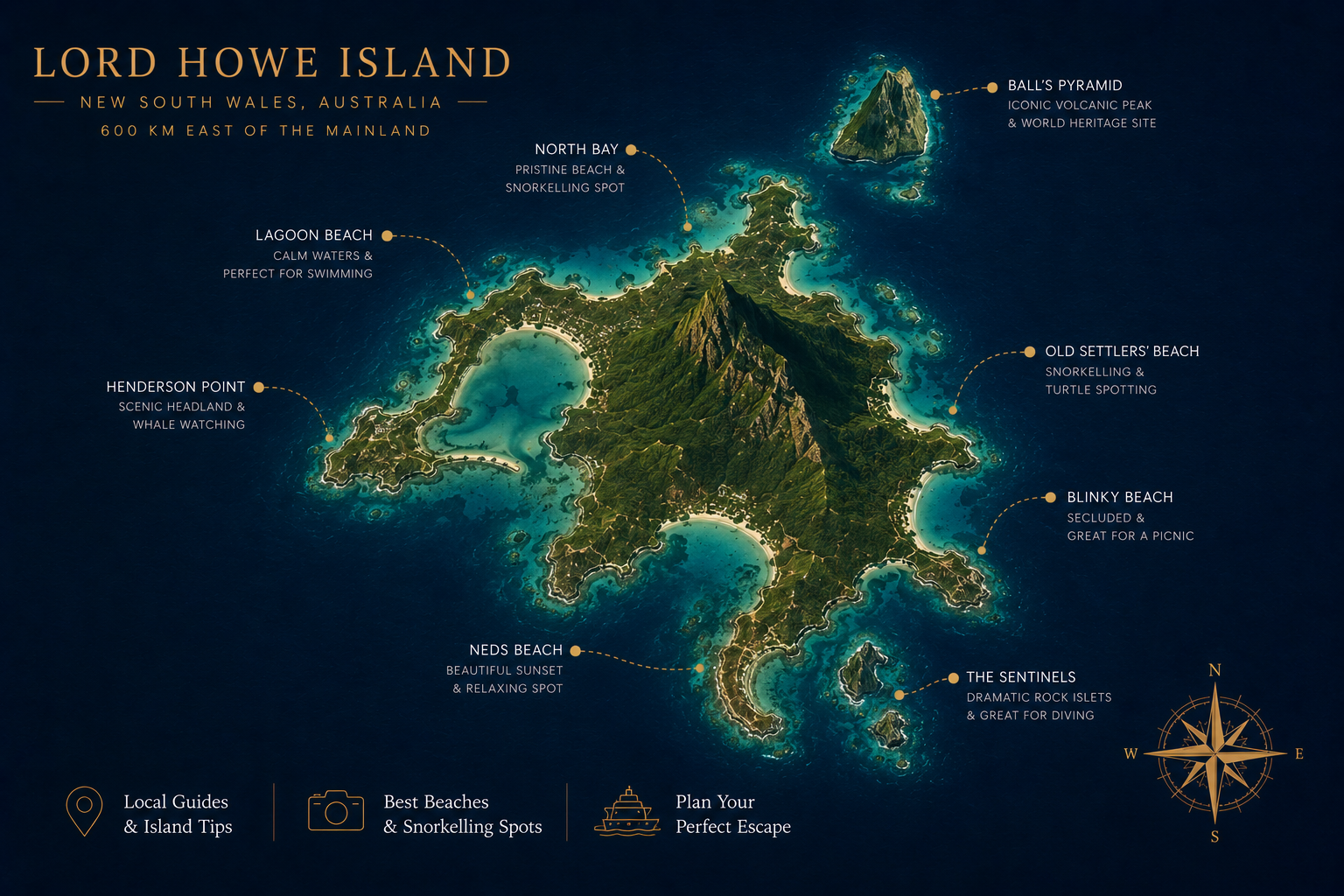
A small volcanic island in the middle of the Tasman Sea with two improbably steep peaks, a coral lagoon you can wade across, and a strict cap of 400 visitors at any one time. There's no mobile signal across most of the island, the airport closes for fog, and you'll likely fall into a slower rhythm within 24 hours of arriving.
- State
- New South Wales
- State capital
- Sydney (780 km west)
- Size
- 14.5 km², 11 km long
- Population
- ~380 permanent + 400 visitor cap
- UNESCO listed
- Yes (1982)
- Best time to visit
- Sept to June (closed mid-winter for some operators)
How to get there
Flights only. There is no ferry, no cruise drop-off, and the few private yachts that visit are met with quarantine inspections.
Qantas flies the route from Sydney (about 2 hours), Brisbane (90 minutes) and Port Macquarie (90 minutes). Flights are on smaller Dash 8 turboprops, the runway can't take a jet. There's only one daily flight from Sydney and weather cancellations are not unusual; budget a buffer day on either end of a tight trip.
Critically: book accommodation before you book flights. The 400-visitor cap is enforced by accommodation availability, every guest must have a confirmed bed before flying in. Popular months book out 6-12 months ahead.
Approximate costs
| Item | Cost (AUD) |
|---|---|
| Return flight from Sydney | $700 to $1,400 |
| Return flight from Brisbane | $650 to $1,200 |
| Self-contained apartment (per night) | $280 to $480 |
| Lodge (per night, all-inclusive) | $700 to $1,500 |
| Capella Lodge (luxury, per night) | $2,000 to $4,500 |
| Bicycle hire (per day) | $22 |
| Mt Gower guided climb | $320 |
| Lagoon glass-bottom boat tour | $95 |
| Snorkel hire (per day) | $25 |
There's no day-tripping. Minimum stay is usually three nights; most accommodation sets four.
What to do
Mount Gower
One of the great day walks in Australia, and not a casual one. 875 metres of climbing, 14 kilometres return, exposed rope-assisted sections, and you must go with a guided tour, solo climbing is not permitted. It takes 8-10 hours and the summit, on a good day, gives you a view that's hard to compare to anywhere else. Goat Island Tours and Sea to Summit are the main operators. Book before you arrive.
The lagoon
The reef-protected lagoon along the western side of the island is bathwater-warm, snorkellable from any of the beaches, and home to over 90 species of coral and 500 fish species. Ned's Beach is the must-do: walk in waist-deep and the kingfish, garfish and trevally swim around your legs. There's an honesty box for fish food (the local pellets, not bread).
Snorkel and dive
Pro Dive does scuba and certified snorkel tours. Drift dives at Admiralty Islands are excellent. The water is unusually clear, visibility 30+ metres is normal in summer.
The Goat House
If Mt Gower is too much, the walk up to The Goat House on Mt Lidgbird gives you most of the view for half the effort. About 3 hours return, last hour is steep.
Just being there
The island is bicycle-ride scale. Speed limit is 25 km/h. Most accommodation has a fleet of bikes for guests. Without phone signal, without a real to-do list, the rhythm of the day reorganises itself around the tide and the bird calls.
When to visit
The shoulder seasons (October, November, March, April) tend to be best, warm enough to swim, fewer fog cancellations, lower flight prices. Summer (December to February) is busy and humid; the lagoon is at its warmest. Winter (June to August) is cooler, with bigger swells around the south of the island, and some lodges close. The bird-watching is excellent year-round; the providence petrels return in March and the woodhen population (rescued from near-extinction in the 1970s) is rebounding.
What to bring
- Reef-safe sunscreen
- Snorkel kit if you don't want to hire
- Hiking boots for Mt Gower
- Waterproof / hiking jacket
- Lightweight long-sleeved shirt
- Walking poles if you use them
- Rashie or wetsuit top in winter
- Cash (a few places don't take card)
- Reading material, there's no streaming
- Patience for delayed flights
A bit of history
Lord Howe is one of the few Australian islands that was uninhabited at first European contact. It was sighted by Lieutenant Henry Lidgbird Ball in 1788 (the year of the Sydney colony) and named after the British First Lord of the Admiralty. The first settlers arrived in the 1830s as a base supplying whaling ships.
The introduction of rats from a shipwreck in 1918 nearly destroyed the island's endemic ecosystem. A massive rat-eradication program completed in 2019 has been one of the most successful conservation actions of its kind anywhere, bird and insect populations are rebounding visibly.
The island was placed on the UNESCO World Heritage List in 1982, recognised for its outstanding example of an oceanic island ecosystem, with high levels of endemism (44% of the plant species, for instance, are found nowhere else on Earth). The 400-visitor cap was set in 1981 and has not changed.
Where this is on the map
600 km east of Port Macquarie, in the Tasman Sea.
Other islands you might pair with this
Norfolk Island is the natural pairing, a similar isolated Pacific outpost, with a different cultural history. Both flights run from Sydney and Brisbane. Bruny Island in Tasmania is the easier-access counterpart for cliffs and isolation.