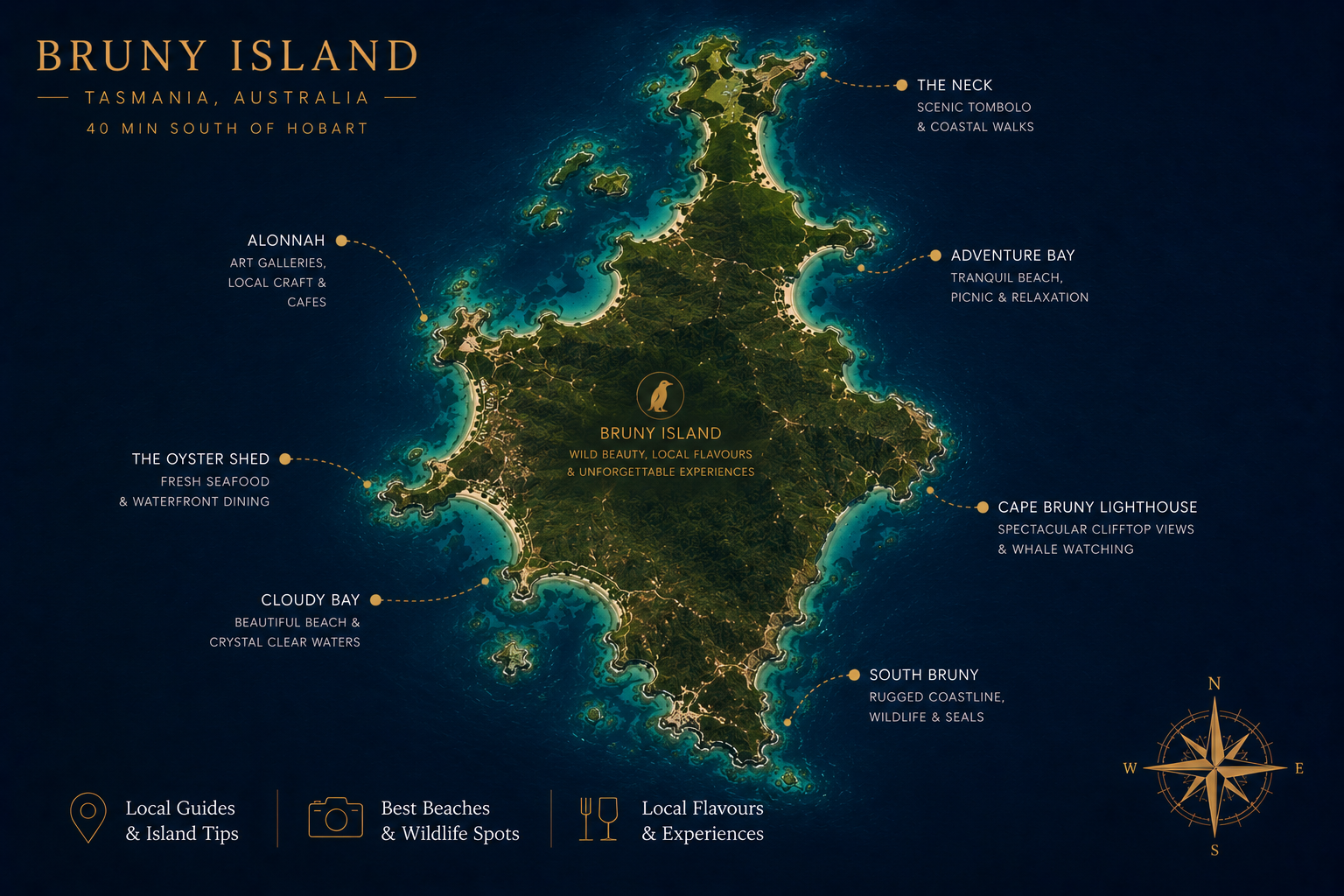
Bruny is two islands joined by a sandy isthmus. North Bruny is open farmland, gentler. South Bruny has steep cliffs falling into the Southern Ocean and a lighthouse perched at the edge. Between them is a strip of beach narrow enough that you can stand on it and see surf on both sides. There are also oysters.
- State
- Tasmania
- State capital
- Hobart (40 km north)
- Indigenous name
- lunawanna-allonah
- Size
- 362 km², 100 km long
- Population
- ~700 permanent
- Best time to visit
- Nov to April (warmer, longer days)
How to get there
Drive from Hobart south to Kettering, 35 minutes. The SeaLink Bruny Island ferry runs every 30 minutes from Kettering to Roberts Point on North Bruny. Crossing time is 15 minutes. There's no booking system, you queue, you board.
You can do Bruny as a day trip from Hobart, but you'd see only a fraction of the island. Most people stay one or two nights to do it justice. Tour operators like Bruny Island Safaris and Pennicott Wilderness Journeys run full-day guided trips from Hobart that include all transfers and food stops.
Approximate costs
| Item | Cost (AUD) |
|---|---|
| Ferry car return (passenger included) | $45 |
| Ferry foot passenger return | $8 |
| Pennicott Wilderness Journeys cruise | $165 |
| Bruny Island Gourmet Tour (full day, ex Hobart) | $215 |
| Self-contained cottage (per night) | $180 to $380 |
| Boutique accommodation | $420 to $700 |
| Cape Bruny Lighthouse Tour | $22 |
| Get Shucked dozen oysters | $24 |

What to do
The Neck Lookout
The signature view. A wooden boardwalk and steps climb to a lookout above the narrow isthmus joining North and South Bruny. Best at sunrise. There's a fairy penguin colony in the dunes here and rangers ask you not to use lights at dusk during nesting season.
Cape Bruny Lighthouse
Australia's second-oldest extant lighthouse, built in 1838, set on a headland above some of the wildest coast in southern Tasmania. Tours run several times daily. The drive in is on a part-gravel road; doable in a 2WD in dry conditions.
Pennicott eco-cruises
The three-hour boat trip down the south-east coast of Bruny is the standout activity. Sea cliffs, sea caves, fur seal colonies, sometimes albatross and dolphins. The boat goes places you can't reach any other way. Book ahead, it's the most popular thing on the island.
Food stops
Get Shucked serves oysters straight from the lease, $2 each at the window, eaten on a deck overlooking the channel. Bruny Island Cheese Co. in Great Bay is the proper Tasmanian artisan operation, try the C2 (a soft washed-rind). Bruny Island Premium Wines is Australia's southernmost vineyard. Hiba is the local boutique whisky producer. Done as a self-drive trip, the food alone is enough reason to come.
White wallabies
South Bruny has a population of pure-white Bennett's wallabies, a recessive gene that's persisted because the island has no foxes. Most easily spotted at dusk near Adventure Bay.
When to visit
November to April is the comfortable window: long daylight, swimmable water (just), most operators running. Summer (December to February) is the busiest, but Bruny rarely feels crowded. Autumn (March to May) has stable weather and the produce is at its best. Winter is cold, with temperatures down to 5°C at night and frequent wind off the Southern Ocean, but if you're already in Tasmania for it, the empty walks and storm-watching are something else.
What to bring
- Layers, Tasmanian weather changes hourly
- Waterproof outer layer
- Walking shoes
- Beanie and gloves outside summer
- Esky / cooler for the food run
- Reusable cup for cellar door tastings
- Cash (a few small operators are cash-only)
- Sunscreen, sun is fierce when it's out
- Insect repellent for dusk walks
- Camera with weather sealing
A bit of history
The Nuenonne people of the Palawa nation lived on Bruny, known as lunawanna-allonah, for at least 6,000 years before European contact. Two of the modern settlements, Lunawanna and Alonnah, take their names from this. The island was the home country of Truganini, often described as the last full-blooded Tasmanian Aboriginal person, born around 1812. Her story, and the broader history of the Palawa, is a profound part of Tasmanian heritage and is acknowledged across the island today.
French explorer Bruni d'Entrecasteaux charted the island in 1792 and gave it his name. The British settled here in the early 19th century, first whalers, then farmers. Cape Bruny Lighthouse was built in 1838 to warn ships off the dangerous southern approaches to the Derwent Estuary.
Bruny's modern reputation as a food destination is comparatively recent, most of the artisan producers established themselves in the 2000s and 2010s, building on a small local farming community.
Where this is on the map
Off Tasmania's southeastern coast, just south of Hobart.
Other islands you might pair with this
If Bruny works for you, Kangaroo Island in SA is the bigger, drier sibling, same drive-yourself, food-and-coast template. Phillip Island in Victoria is the easier mainland-adjacent cousin.