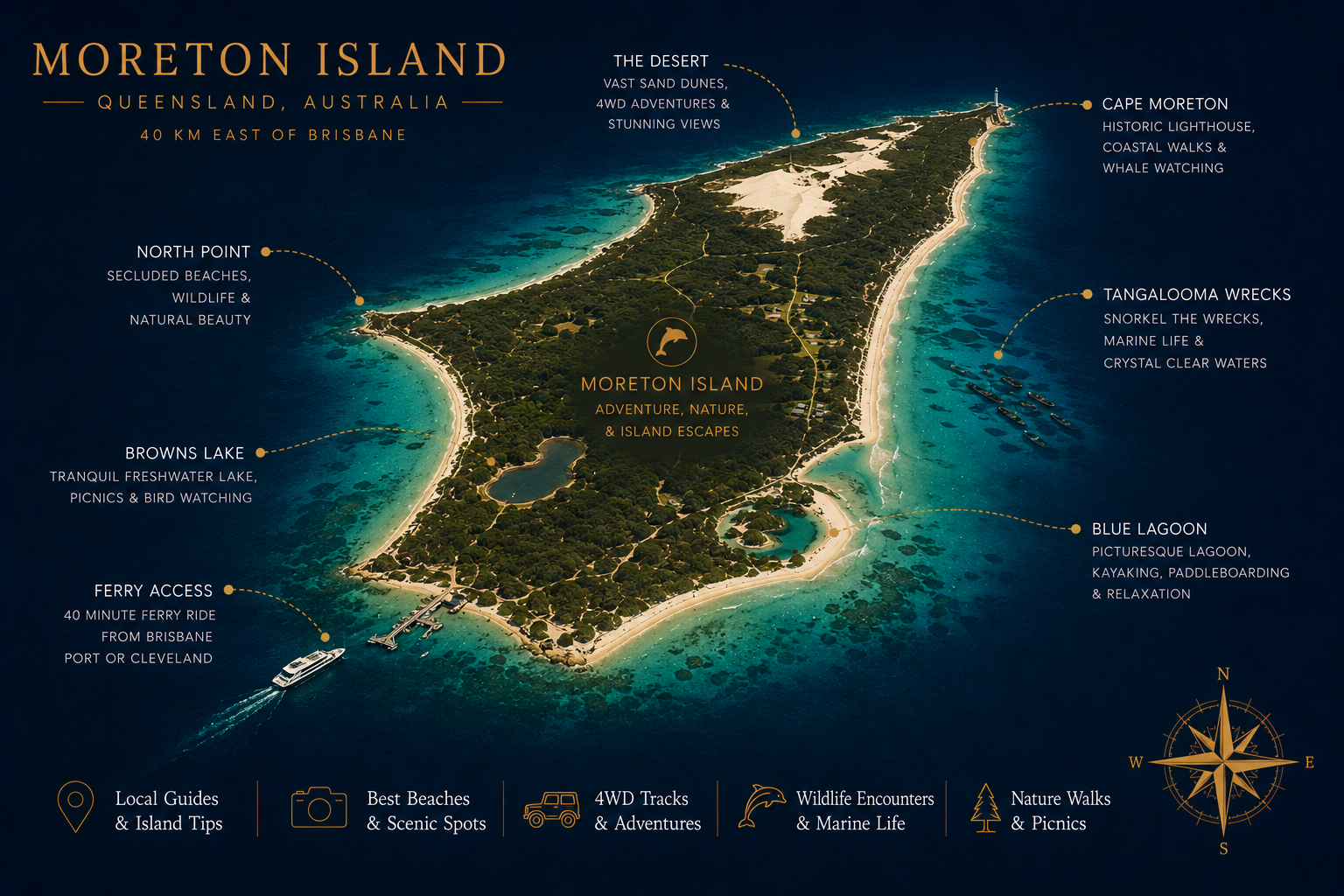
Moreton is the third-largest sand island on Earth, bigger than Stradbroke, smaller than K'gari. There's a single resort at Tangalooma, a couple of small settlements, and 95 percent of the island is national park. The wrecks of 15 deliberately sunk vessels lie 50 metres off the beach, creating one of the easiest shore-snorkel sites in Australia. At sunset, wild bottlenose dolphins come into Tangalooma's jetty to be hand-fed.
- State
- Queensland
- State capital
- Brisbane (40 km west)
- Indigenous name
- Mulgumpin
- Traditional Owners
- Quandamooka people
- Size
- 186 km², 38 km long
- Population
- ~250 permanent
- Best time to visit
- April to Nov
How to get there
The Tangalooma Flyer catamaran runs from Pinkenba in Brisbane (next to the cruise terminal), 75 minutes, drops you straight at the resort jetty. Vehicle access is via the MICAT car ferry from the Port of Brisbane, around 90 minutes. You need a 4WD on Moreton, there are no sealed roads, the "highways" are sand tracks and the beach itself.
Day trips from Brisbane are popular but you'll only see the resort area. To explore the rest, the freshwater lagoons, the eastern surf beach, Mt Tempest, you need to stay at least one night.
Approximate costs
| Item | Cost (AUD) |
|---|---|
| Tangalooma Flyer return (adult) | $95 |
| MICAT vehicle ferry return (4WD) | $240 to $300 |
| 4WD permit (per vehicle) | $57 |
| Tangalooma Resort (per night) | $280 to $620 |
| Camping (per family, per night) | $30 |
| Sand tobogganing tour | $48 |
| Snorkel hire at Tangalooma (per day) | $25 |
| Day trip with dolphin feed | $155 to $185 |
What to do
The Tangalooma Wrecks
Fifteen old hulks, barges, dredges, a cement carrier, were intentionally scuttled in shallow water during the 1960s and 70s to create a small-boat harbour. The reef has colonised them aggressively. You snorkel directly off the beach: turtles, wobbegongs, schooling fish, occasionally a passing dolphin. Visibility is best on incoming tide, mornings.
Wild dolphin feeding
Every evening at sunset, around 8 wild bottlenose dolphins approach the Tangalooma jetty for a controlled feeding program that's been running since 1992. Resort guests can wade in and hand-feed them under ranger supervision. It's regulated to a small daily portion (less than 10% of their daily food intake) so the dolphins remain wild hunters.
The Desert and sand tobogganing
An expanse of bright white sand dunes near the centre of the island, yes, it looks like an actual desert. Resorts run guided tobogganing trips: you sit on a polished masonite board and slide down a 50-metre dune, often hitting 25 km/h. Surprisingly fun.
Champagne Pools and Honeymoon Bay
On the east coast, a series of natural rock pools where the surf bubbles over a low rock shelf. Sheltered enough to swim in, dramatic enough to be photogenic.
Mt Tempest
One of the highest coastal sand dunes in the world at 280m. The walk up takes 45 minutes, the view is across the whole island. Don't go in the heat of the day.
When to visit
April to November is the comfortable window, clear water for the wrecks, dolphins year-round, no jellyfish. Whales pass close to the island June to October. Summer is humid and the wet brings mosquitoes. School holidays book up; book the resort 6+ months ahead for peak weeks.
What to bring
- Reef-safe sunscreen
- Mask and snorkel (or hire)
- Reef shoes for the wrecks
- Hat, sunglasses
- Light long sleeves
- Insect repellent
- Plenty of drinking water
- 4WD recovery gear if self-driving
- Tide chart
- Cash for the small store
A bit of history
Moreton, known to the Quandamooka people as Mulgumpin, has been continuously inhabited for at least 25,000 years. Stone tool sites along the western shore document the long Indigenous occupation.
European exploration began with Cook's 1770 voyage; Cook named Moreton Bay after the Earl of Morton (and a clerical error gave the island the same name with an added "e"). A whaling station operated at Tangalooma from 1952 to 1962, at its peak the largest in the southern hemisphere, processing over 6,000 humpback whales. The whaling stopped when the population had been hunted close to extinction. The site became the Tangalooma resort in 1963; the dolphin feeding program emerged organically in the 1980s when wild dolphins began approaching the resort jetty for fish scraps.
Most of the island was declared national park in 1966, with permanent settlement restricted to the west coast.
Where this is on the map
In Moreton Bay, just north of North Stradbroke, off Brisbane.
Other islands you might pair with this
North Stradbroke is the natural pair, its southern neighbour in Moreton Bay, easier ferry, easier on a 2WD. K'gari (Fraser Island) is the bigger, wilder, sandier sibling further north.