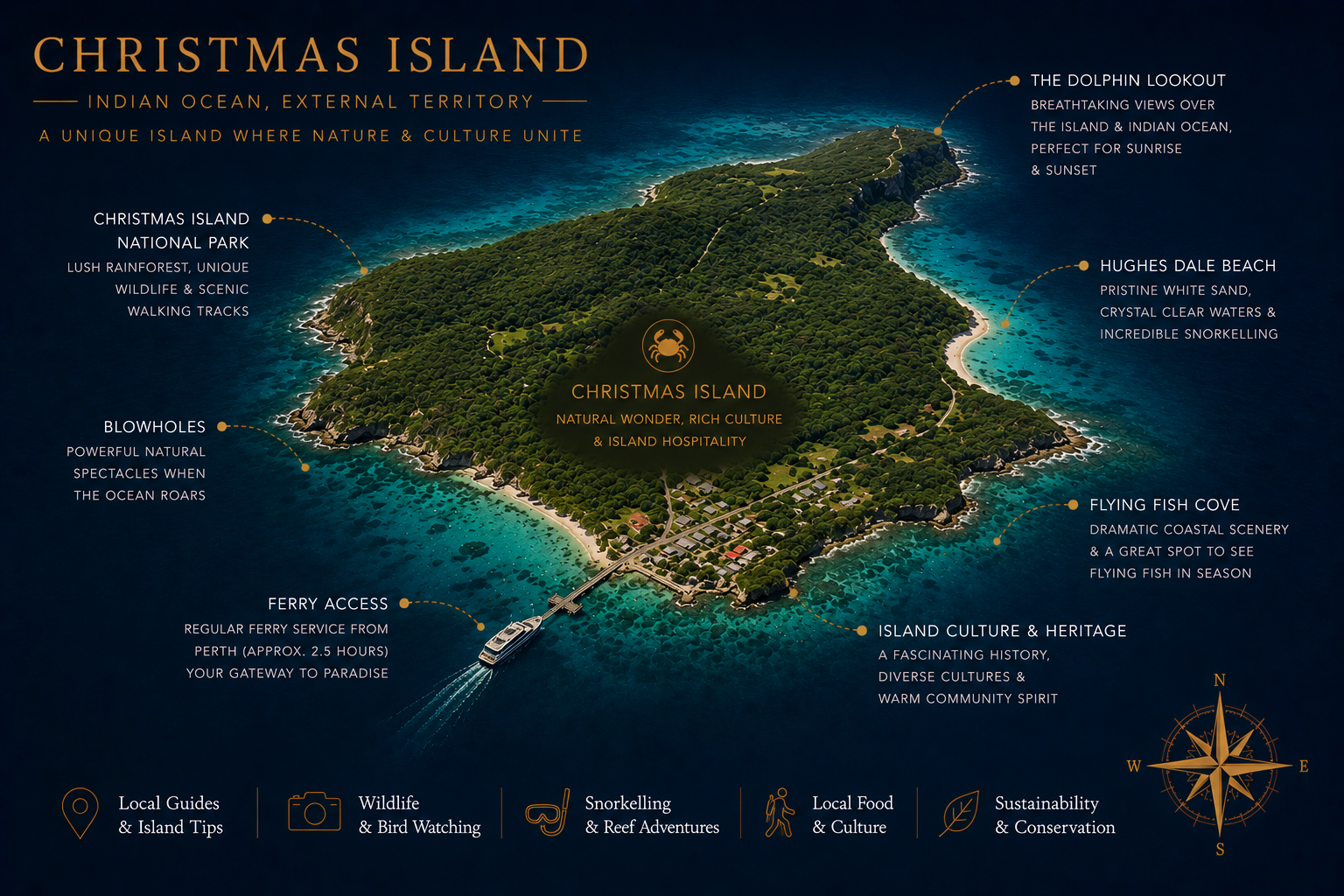
Once a year, around 50 million red crabs leave the rainforest, cross the roads, march down the cliffs, and arrive at the sea to spawn. The whole island runs on the crabs' clock during migration, bridges close, roads divert, and the rangers escort the columns. The rest of the year, it's a wild, jungle-covered chunk of limestone that drops straight into deep ocean. Diving here is on the same scale as Pacific island destinations.
- Status
- Australian External Territory
- Nearest mainland
- Perth (2,600 km southeast)
- Size
- 135 km²
- Population
- ~1,800 permanent
- Time zone
- UTC+7 (90 min behind Perth)
- Best time to visit
- Crab migration: Oct to Dec; diving: April to Nov
How to get there
Flights from Perth only. Virgin Australia operates a service to Christmas Island typically twice a week, sometimes routing through Cocos Keeling. Flight time is about four hours from Perth. Fares vary widely; off-season they can be reasonable, peak crab migration weeks they spike.
You'll want a 4WD on the island. Most accommodation packages include a vehicle. Roads are partly sealed, partly dirt; some attractions require crossing rough tracks.
Despite being an Australian territory, you'll go through customs and biosecurity in both directions. Bringing fresh food in is restricted. Fuel is more expensive than mainland Australia.
Approximate costs
| Item | Cost (AUD) |
|---|---|
| Return flight from Perth | $900 to $1,800 |
| 4WD hire (per day) | $120 to $180 |
| Self-contained accommodation (per night) | $200 to $380 |
| Boutique stay (per night) | $380 to $620 |
| Crab migration tour with ranger | $95 |
| Cert dive (per dive) | $130 |
| Whale shark snorkel tour (in season) | $320 |
| 5-night package (typical) | $2,400 to $4,800 pp |
Prices peak November-December for crab migration. Book accommodation 6+ months ahead for that window.
What to do
The red crab migration
The headline event. Triggered by the first significant rainfall after the dry season, usually late October to early December, but the exact timing varies year to year by up to four weeks. Around 50 million adult crabs descend en masse from the inland rainforest, march for a week or so to reach the sea, spawn, and return. Local rangers build temporary "crab bridges" over roads and put up barricades to protect the migration routes. Some roads close for periods. The whole community accommodates the crabs, not the other way around.
Diving and snorkelling
The island sits on a steep oceanic drop-off, within metres of shore the seabed plunges past 200 metres. Reef sharks, whale sharks (in season), tropical fish, and unusual species like dwarf hawkfish that aren't found anywhere else. Visibility is consistently 30+ metres. Wreck dives include the Eidsvold, sunk in WWII.
The Dales
A series of rainforest waterfalls and freshwater pools at the eastern side of the island. The walk in is moderate; the swim at the bottom of Hosnies Spring is a reward. Robber crabs (the world's largest land crab, up to 4 kg) live in the rainforest and you'll see them on the track.
Bird-watching
Two endemic seabirds: the Christmas Island frigatebird and the Abbott's booby. The Abbott's booby colony at Margaret Knoll is one of the most accessible viewing sites for either species. Birdlife International rates Christmas Island as a Tier-1 endemic bird area.
Whale sharks
Whale sharks aggregate seasonally around Christmas Island, attracted by red crab spawn in the water during migration aftermath. Snorkelling alongside them is offered through licensed operators, generally November to April.
When to visit
The big choice is whether you're coming for the crab migration or for diving. Crab migration peaks late October to early December, this is the most-anticipated tourist event. Whale sharks are most reliably present November to April. Diving is best in the calmer months April to October. The island has a wet season (December to April) and a dry season (May to November); the wet season is hotter and stickier but greener.
What to bring
- Reef-safe sunscreen
- Lightweight long sleeves and pants
- Walking shoes / hiking sandals
- Insect repellent (very strong)
- Stinger suit / wetsuit for diving
- Snorkel and mask
- Camera with macro lens
- Australian power adaptor
- Cash (small economy, some places card-only)
- Patience, island time is real
A bit of history
Despite the name, Christmas Island had no permanent inhabitants when Captain William Mynors of the British East India Company sighted it on Christmas Day, 1643. It was largely ignored for two centuries until rich phosphate deposits were discovered in 1888, at which point the British government claimed it.
Phosphate mining began in 1899, with workers brought in primarily from China, Malaya and the Cocos Keeling Islands. Today's population is multicultural, roughly 65% Chinese-Australian, 12% Malay-Australian, 20% European-Australian, and the island has Buddhist, Christian, Muslim and Bahá'í communities all visible in everyday life.
Christmas Island was occupied by Japan from 1942 to 1945, with most workers and their families interned. After the war, mining resumed; the territory was administered by Singapore until 1958, when it transferred to Australia. The phosphate industry continues today on a smaller scale, alongside tourism and the controversial detention facility (now mostly used for non-residential purposes).
The crab migration was first scientifically described in the 1970s and has since become one of the most-studied animal migrations on Earth.
Where this is on the map
2,600 km west of Perth, in the Indian Ocean, actually closer to Java than to mainland Australia.
Other islands you might pair with this
The natural pairing is Cocos (Keeling) Islands, sister Indian Ocean Territory, often combined into a single longer trip. Many flights actually link the two. Lord Howe Island is the eastern equivalent for "remote Australian island worth the journey."