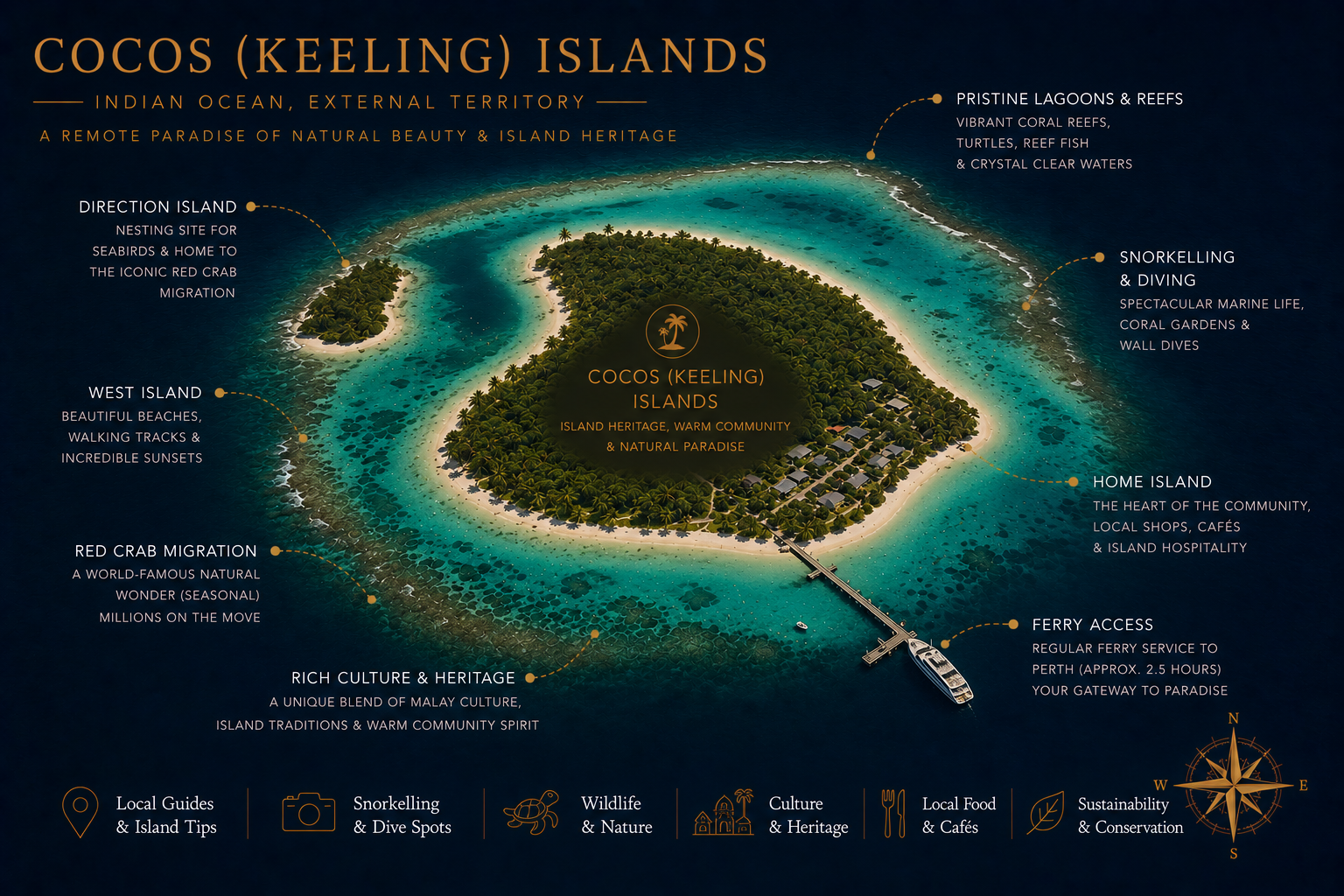
Cocos is an actual coral atoll, two atolls, in fact, sitting 2,750 km from Perth and 1,000 km from anywhere else. Twenty-seven small islands ringing turquoise lagoons. Two have a permanent population: West Island (mostly European-Australian, with the airport) and Home Island (almost entirely Cocos Malay). The kitesurfing in the southern lagoon is internationally rated. Almost nobody you'll meet on the mainland has been here.
- Status
- Australian External Territory
- Nearest mainland
- Perth (2,750 km southeast)
- Size
- 14 km² total land, two atolls
- Population
- ~600 permanent
- Time zone
- UTC+6:30 (2 hours behind Perth)
- Best time to visit
- April to Nov (dry season)
How to get there
Flights from Perth only. Virgin Australia operates the route, typically twice a week, sometimes via Christmas Island. Flight time is about 4½ hours direct from Perth. Plan around the schedule, there are no daily flights, and missing a flight can mean three or four days waiting.
You'll arrive at West Island airport. To visit Home Island (where most of the Cocos Malay community lives), take the inter-island ferry, about 30 minutes, runs several times daily, very cheap.
Most visitors hire a small car or a scooter on West Island. The whole island is 11 km long, so distances are minimal, but having wheels gives you flexibility to reach the southern beaches and lagoon.
Approximate costs
| Item | Cost (AUD) |
|---|---|
| Return flight from Perth | $900 to $1,800 |
| Inter-island ferry (return) | $5 |
| Car / scooter hire (per day) | $60 to $100 |
| Self-contained accommodation (per night) | $220 to $380 |
| Boutique stay (per night) | $320 to $580 |
| Direction Island day trip / charter | $95 |
| Kitesurf lesson (2 hours) | $210 |
| Cert dive (per dive) | $130 |
| 5-night package (typical) | $2,400 to $4,200 pp |
What to do
Direction Island ("DI")
This is the one to do. A small uninhabited island within a 10-minute boat ride from Home Island, accessible most days via the dedicated ferry. The "Rip" off DI's southern end has fast-flowing channel currents that you can drift-snorkel: get dropped in, lie back, and the current carries you over reef teeming with fish. There are two beaches, a few picnic shelters, and basic toilets, that's it.
Kitesurfing
Cocos has consistent year-round trade winds and an enormous shallow lagoon. The kitesurfing here is rated in the world's top 10 by people who'd know. Multiple operators run schools and rentals. Even non-kitesurfers can hire stand-up paddleboards and use the lagoon.
Cocos Malay culture on Home Island
Home Island has been the centre of Cocos Malay community since the 1820s. Around 80% of the island's population lives here. The language is a Malay dialect with significant English influence. The Cultural Centre and the Hari Raya celebrations (after Ramadan) are open to respectful visitors. Pay attention to local etiquette, modesty in dress is expected on Home Island in a way it isn't on West Island.
Diving
Cocos sits on a deep oceanic mount, like Christmas Island. Outside the lagoon, the seabed plunges past 200 metres within metres of shore. Reef sharks, eagle rays, occasional whale sharks. The diving is technically excellent and almost always uncrowded.
Just walking
The southern end of West Island has empty white-sand beaches with nobody on them. The cycle ride out to Trannies Beach takes about 30 minutes and the reward is your own private bay.
When to visit
April to November is the dry season, the most reliable weather, best for kitesurfing (consistent 15-25 knot trades), best diving visibility. December to March is the wet season: cyclone risk, hotter, stickier, occasional heavy rain. The trade winds are more reliable in dry season; the kitesurfing is best between June and September.
What to bring
- Reef-safe sunscreen
- Hat with chinstrap (constant wind)
- Lightweight long sleeves
- Snorkel kit if you have one
- Reef shoes (essential for the Rip)
- Modest clothing for Home Island
- Cash, limited card facilities on Home Island
- Insect repellent
- Australian power adaptor
- Patience for inter-island timing
A bit of history
Cocos was uninhabited until 1825, when British sea captain William Keeling sighted (and named) the islands, and 1826 when the Scottish merchant Alexander Hare brought a group of Malay slaves and concubines to settle Home Island as a private fiefdom. John Clunies-Ross arrived shortly after as Hare's rival and effectively ran the islands as a personal possession from 1827 to 1978, five generations of his family ruled Cocos as the "Clunies-Ross dynasty." Workers, brought from Malaya and elsewhere, were paid in plantation tokens that could only be spent at the Clunies-Ross store.
This is one of the more uncomfortable colonial histories in Australian territory. In 1978, after a UN-supervised investigation, the Australian government bought the islands from John Clunies-Ross. In 1984 the Cocos Malay community voted overwhelmingly to integrate fully with Australia, the only Indian Ocean territory to do so by referendum. The Clunies-Ross family lost most of their property in subsequent legal proceedings.
The Cocos Malay community today has full Australian citizenship, retains its language and culture, and Home Island remains Malay-majority. The Cocos Malay are recognised as a distinct community under Australian heritage law.
Charles Darwin visited Cocos in 1836 on the Beagle. His observations of coral atoll formation here were instrumental in his theory of how atolls form, gradual subsidence around an extinct volcano, with coral reef growing upward to maintain a ring near the surface.
Where this is on the map
2,750 km west of Perth, closer to Sri Lanka than to mainland Australia.
Other islands you might pair with this
The natural pairing is Christmas Island, sister Indian Ocean Territory, often combined into a single trip with a stopover. Rottnest Island off Perth is the obvious WA precursor before flying further west.