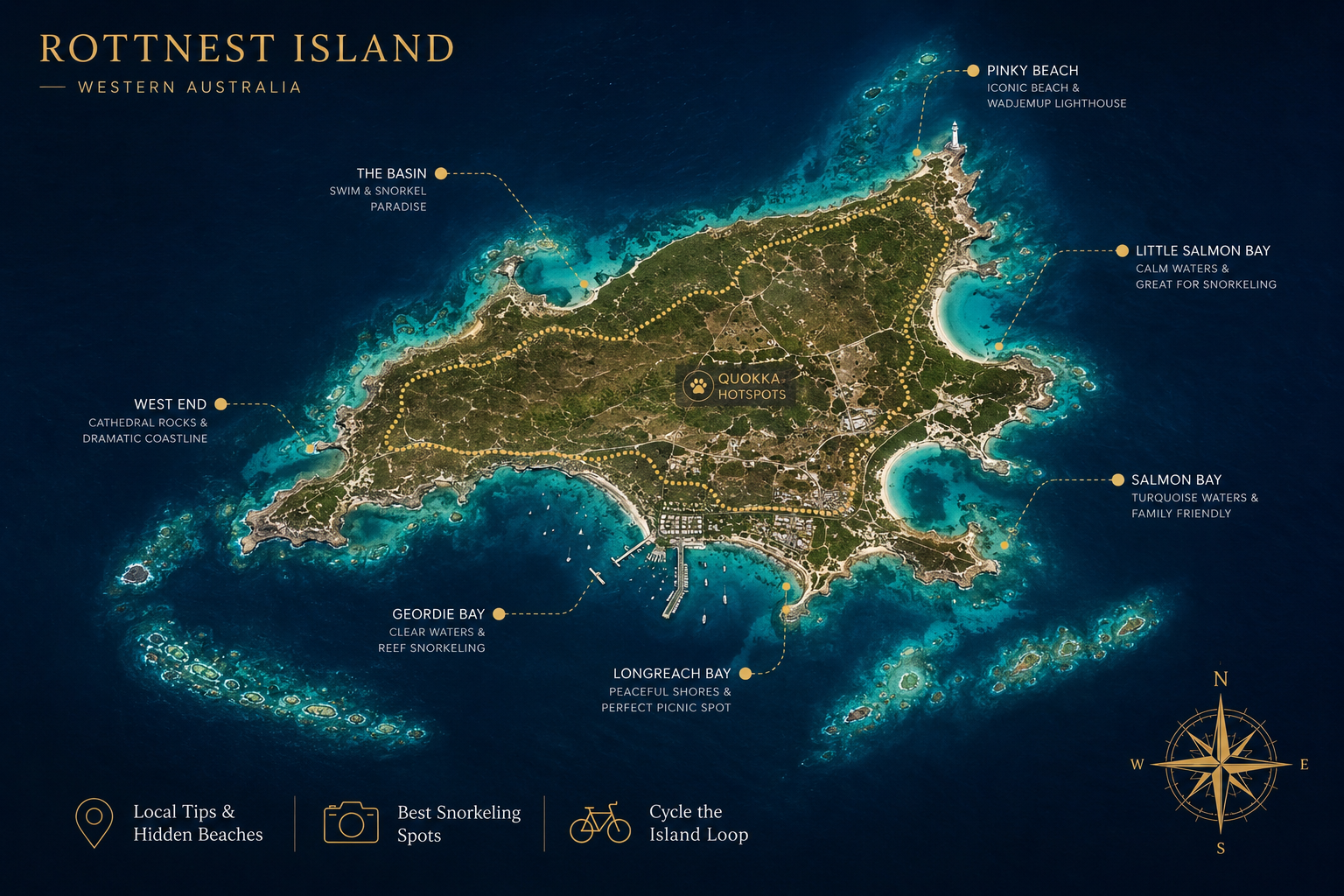
If you have a single afternoon in Perth and you want to do the most Western Australian thing possible, you take the ferry to Rottnest. Quokkas, white sand, no cars, and water that doesn't quite look real until you're swimming in it.
- State
- Western Australia
- State capital
- Perth (60 km east)
- Aboriginal name
- Wadjemup
- Size
- 19 km², 11 km long
- Population
- ~300 permanent
- Best time to visit
- Sept to Nov, March to May
How to get there
Three ferry departure points and one tiny airport. Most people take a boat from Fremantle, it's the closest mainland point and the trip takes about 25 minutes. Ferries from Perth city (Barrack Street Jetty) take longer because they sail down the Swan River first; that's a scenic journey, not a fast one. Hillarys is a third option, useful if you're staying in the northern suburbs.
Two main ferry operators run year-round: Rottnest Express and SeaLink Rottnest Island. Prices and timetables are similar enough that the right one is whichever leaves when you want to leave. Book ahead during school holidays and weekends, the morning sailings sell out.
Flying with Rottnest Air Taxi takes about 12 minutes from Jandakot. It costs roughly four times the ferry but the views are extraordinary.
Approximate costs
| Item | Cost (AUD) |
|---|---|
| Ferry day return from Fremantle (adult) | $70 to $90 |
| Ferry day return from Perth (adult) | $110 to $135 |
| Ferry day return from Hillarys (adult) | $95 to $115 |
| Island admission fee (adult, day) | $23 |
| Bike hire (day) | $30 to $42 |
| Bus day pass (Island Explorer) | $25 |
| Accommodation (cottage, per night) | $250 to $550 |
| Glamping / tents (per night) | $190 to $320 |
Most ferry packages bundle the admission fee with bike hire, read the fine print. Prices nudge upward every September.

What to do
Most people hire a bike on arrival and ride a loop. The full circumnavigation is around 22 km on sealed roads with some hills, it'll take a fit person three or four hours with stops. If you're not a cyclist, the Island Explorer bus does a hop-on-hop-off route covering all the major beaches.
Beaches worth the detour
The Basin is the postcard one, a sheltered lagoon ringed by reef, easy snorkelling, busy on weekends. Pinky Beach sits below the lighthouse and gets less crowd. Salmon Bay on the south side is bigger, wilder and good for swimming when the wind is from the north. Little Salmon Bay has a marked snorkel trail with underwater plaques.
The quokka thing
You will see quokkas. They live across the whole island and aren't shy. The rules: don't touch them, don't feed them, don't pick them up. Selfies are fine if you crouch down and hold the phone low, they're curious and will often come to you. Most visitors get a usable shot near the bakery in the main settlement at Thomson Bay. Fines for inappropriate handling start at $300.
Snorkel and swim
The water clarity around Rottnest is exceptional in summer. There's a coral reef. There are wrecks. There are seagrass meadows full of fish. Bring a mask or hire one near the main jetty. The water is cold-ish year-round, average summer temp is around 22°C, but bearable without a wetsuit from December to April.
The lighthouse and the salt lakes
Wadjemup Lighthouse on the highest point of the island gives you a view across the whole place. Tours run a few times a day. The salt lakes in the interior look wrong-coloured because they are, they're hyper-saline and pink in patches.
When to visit
March through May is probably the sweet spot, water still warm, school holidays over, southerly winds are gentler. September through November is the second window, with wildflowers across the island's centre and whales sometimes visible from the south coast. Avoid the week between Christmas and New Year unless you've booked accommodation months in advance and don't mind crowds. Winter (June to August) is quiet, often wet, and the ferries can be cancelled in big swells.
What to bring
- Reef-safe sunscreen (more than you think)
- A hat with a chinstrap, wind is constant
- Swimmers and a quick-dry towel
- Snorkel kit if you have one (hire is fine)
- Water bottle, refill stations are plentiful
- Cash isn't really needed; everywhere takes card
- Rashie or wetsuit top in shoulder seasons
- Reef shoes for rocky entries
- A windbreaker, even in summer
- Snacks if you're cycling far, there's only one bakery
A bit of history
The Whadjuk Noongar people knew the island as Wadjemup, "place across the water." Until rising sea levels around 7,000 years ago, it was connected to the mainland.
Dutch explorer Willem de Vlamingh landed in 1696, mistook the quokkas for giant rats, and named the place "Rottenest", rats' nest. The misidentification stuck.
Less cheerful: from 1838 to 1931, Rottnest was used as an Aboriginal prison. At least 369 men and boys died there and are buried on the island, in what for a long time was an unmarked burial ground. Reconciliation work and proper memorials only began in earnest in the 2000s. The lighthouse and many of the island's stone buildings were built using Aboriginal prison labour. It's a heavy history under all the holiday postcards, and worth knowing before you arrive.
The island also served as a military base during both world wars, the gun emplacements at Oliver Hill and Bickley are still there, and you can tour the Oliver Hill tunnels.
Where this is on the map
Rottnest Island sits 19 km off Perth's coast, west of Fremantle.
Other islands you might pair with this
If you're already in Perth: Penguin Island is an hour's drive south and a five-minute ferry, completely different in scale, easier as a half-day. Further afield, Kangaroo Island in South Australia gives you the Aussie-island-with-cars experience that Rottnest deliberately avoids.