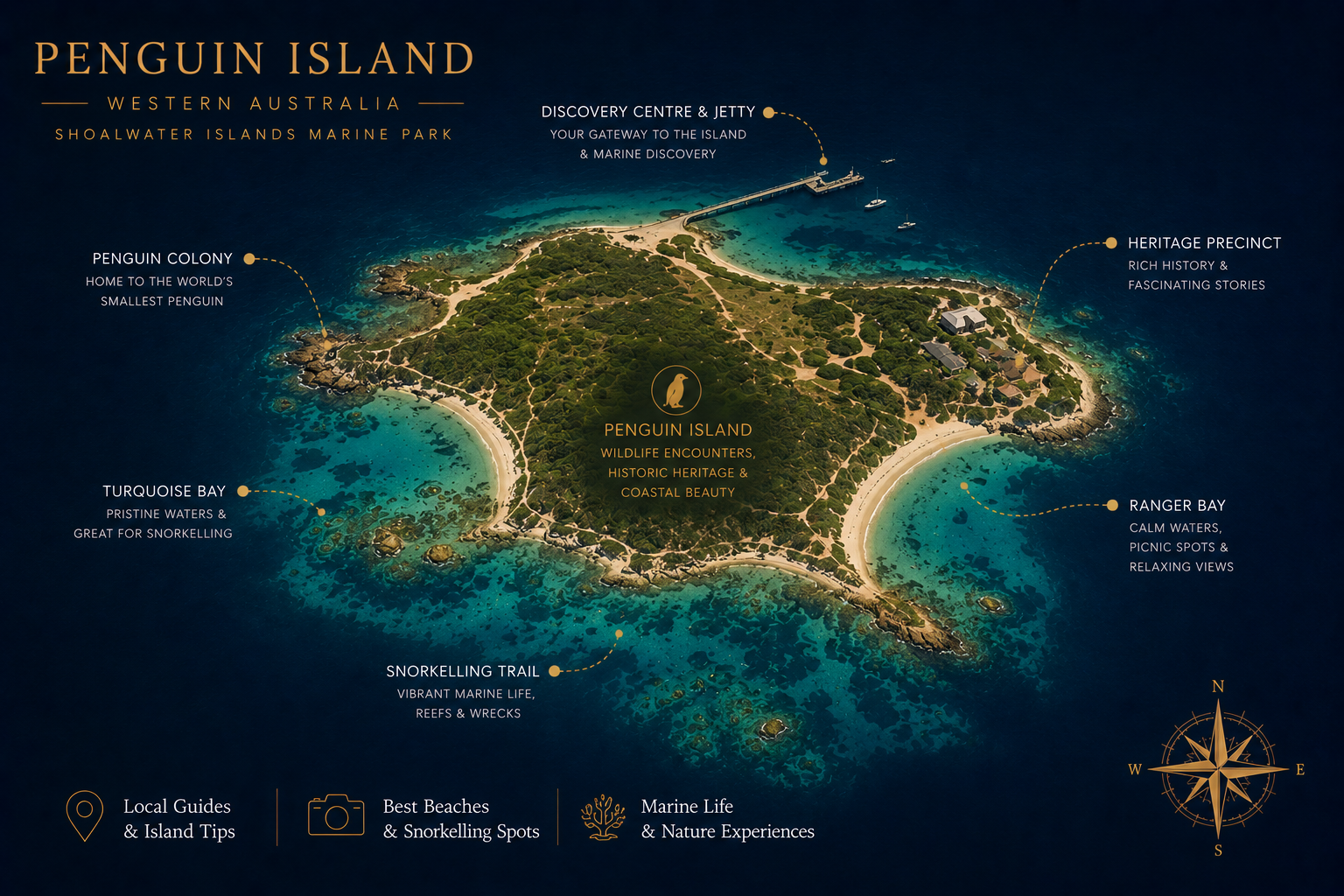
If Rottnest feels like a commitment, Penguin Island is the half-day version. A five-minute ferry from Rockingham, walkable end to end in an hour, with a colony of little penguins, a constant pelican squabble, and water shallow enough to wade across to Seal Island in summer.
- State
- Western Australia
- State capital
- Perth (50 km north)
- Size
- 0.125 km²
- Population
- None (rangers only)
- Closed
- 5 June to 14 September annually
- Best time to visit
- Sept to April
How to get there
From Perth, drive south to Rockingham, about 50 minutes if traffic is reasonable, longer in peak hour. Park at Mersey Point in Shoalwater. The Penguin Island ferry runs a five-minute crossing every half hour during the open season.
If you don't have a car: catch the train to Rockingham then a local bus to Mersey Point. It's doable but adds an hour each way.
You technically can kayak across or wade at very low tide, but the marine park rangers will tell you not to. Stingrays, currents, and disturbance to penguin habitat are all real concerns.
Approximate costs
| Item | Cost (AUD) |
|---|---|
| Ferry return (adult) | $22 |
| Ferry return (child) | $18 |
| Discovery Centre entry (adult) | $15 |
| Wildlife cruise (Shoalwater) | $60 to $90 |
| Kayak hire / SUP (Mersey Point) | $30 / hr |
There's no accommodation on the island. Day visits only.
What to do
The Discovery Centre at the northern end is small but worth the entry, they do feeding sessions for rescued penguins three times a day, and you'll learn more about how the colony is doing than you'll get anywhere else. (Spoiler: it's been a hard decade for them. Numbers have dropped from over 1,300 in 2007 to a few hundred today, mostly due to heat and predation.)
The boardwalk loop takes 30 minutes if you stop and read the signs. There's a swimming beach on the east side facing the mainland, more sheltered than the west. The west side has more dramatic limestone cliffs and bigger waves, good for a wander but rougher swimming.
Wild penguins are nocturnal. You won't see them in the open during the day. The penguins on display are rehab birds. If you really want to see wild ones, you'd need a permit, a guide, and a dawn or dusk visit, generally only available through researcher access.
Pelicans, on the other hand, are everywhere. The colony at the southern end is loud and territorial.
Sea lions sometimes haul out on the beaches. Don't approach within 10 metres, fines apply, and they're more dangerous than they look.
When to visit (and the closed season)
The island is closed to the public every year from 5 June to 14 September. This is the penguin breeding season and it's not negotiable, the rangers really do enforce it. Plan around this if you're visiting in winter.
Outside the closure, summer is busiest, especially weekends in January and February. The water's at its warmest and clearest then. Spring (October to November) is a good middle ground: warm enough to swim, fewer people.
What to bring
- Hat, there's almost no shade
- Sunscreen and a rashie
- Picnic lunch, there's a small cafe but limited
- Snorkel kit (optional but worth it)
- Reusable water bottle
- Cash for the ferry isn't required, card works
- Closed shoes for the boardwalk
- A book, there's not much to do once you've walked it
A bit of history
The island sits in country of the Whadjuk Noongar people, part of the Greater Bibbulmun nation. The penguin colony on the island was identified in the 1950s. For a brief period in the 1980s, a private operator ran a "penguin park" that involved enclosures and feeding shows, that operation closed in the 2000s as conservation thinking evolved, replaced by the current Discovery Centre with rescued birds and minimal handling.
The Shoalwater Islands Marine Park, declared in 1990, protects this island plus Seal Island, Bird Island and Penguin's smaller neighbours. It's one of the most accessible marine parks in Australia.
Where this is on the map
50 km south of Perth, in Shoalwater Islands Marine Park.
Other islands you might pair with this
The natural pairing is Rottnest Island, same coast, opposite scale. If you want something completely different, Bruny Island in Tasmania is also famous for little penguins, with a much wilder feel.