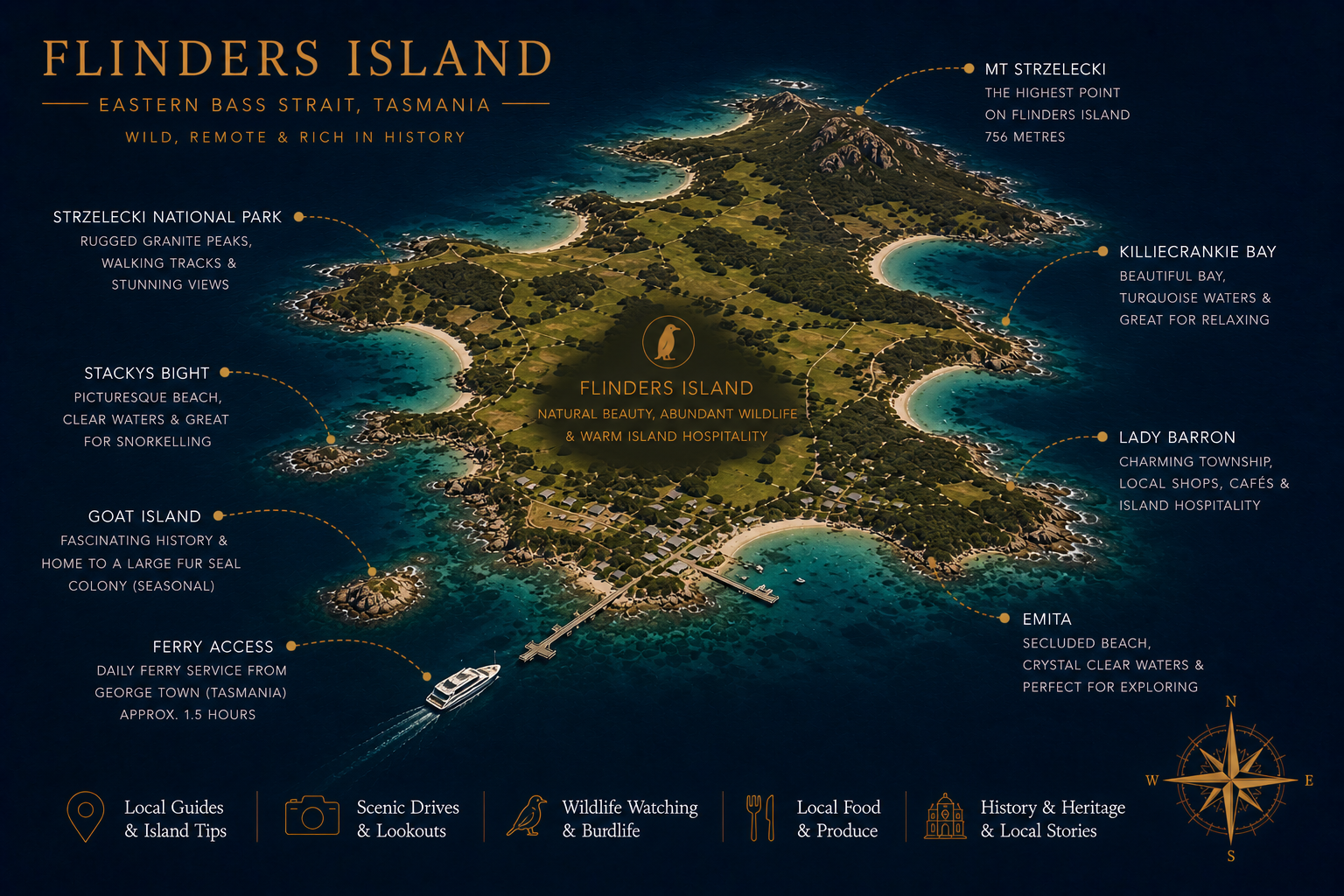
The biggest of the Furneaux Group, set in the eastern entrance to Bass Strait. Granite peaks rising sharply from the sea, white-quartz beaches, an empty network of dirt roads, and a wombat population so confident that you'll dodge them on the way back from dinner. Quietly one of the best walking destinations in southern Australia.
- State
- Tasmania
- State capital
- Hobart (300 km southwest)
- Indigenous name
- truwana
- Size
- 1,367 km², 75 km long
- Population
- ~900 permanent
- Best time to visit
- Oct to April
How to get there
Flights only. Sharp Airlines operates the regular service from Launceston (40 minutes) and Melbourne (Essendon) (60 minutes). Both run several times a week. There's no service from Hobart direct, you'd connect through Launceston.
The freight ferry from Bridport in Tasmania does take a small number of vehicle and foot passengers, but schedules are limited and weather-dependent. Most visitors fly and hire a vehicle on the island.
You'll want a car. Distances are real (Whitemark to Killiecrankie at the north tip is 50 minutes), most attractions are on minor roads, and there's no public transport.
Approximate costs
| Item | Cost (AUD) |
|---|---|
| Return flight from Launceston | $340 to $520 |
| Return flight from Melbourne | $420 to $680 |
| Hire car (per day) | $80 to $130 |
| B&B / cottage (per night) | $160 to $290 |
| Boutique stay (per night) | $320 to $580 |
| Strzelecki National Park entry (per vehicle) | $24 |
| Self-guided 4-day Wybalenna walk | $0 (free) |
What to do
Strzelecki Peaks
The signature climb. 5.5 km return, 750 m of elevation gain through grasstrees and granite. The summit at 756 m is one of the highest points on any Australian island. The view is across the entire Furneaux Group, the Bass Strait shipping lanes, and on a clear day, both mainland Tasmania and Wilson's Promontory in Victoria. Allow 4-5 hours.
Killiecrankie
A small bay at the north end of the island, famous for "Killiecrankie diamonds", actually topaz and quartz crystals, eroded out of the granite. You can fossick on the beach for them; some are gemstone-quality and sold by local jewellers in Whitemark.
Wybalenna
Possibly the most important Aboriginal heritage site in Tasmania, and a place that requires acknowledgment before discussion. From 1834 to 1847, the surviving Tasmanian Aboriginal population, relocated under coercion by George Augustus Robinson, was held here under disastrous conditions. Most died. The Wybalenna chapel and graveyard have been returned to Aboriginal ownership and are a site of mourning and ongoing cultural significance. Visitors are welcome but the place is solemn; behave accordingly.
The beaches
Trousers Point at the southern end: white-quartz sand, granite outcrops, calm bays. Sawyers Bay and Lillies Beach on the east coast are wilder and rarely have anyone on them. Walker's Lookout gives you the best aerial-without-flying view of the central plain.
Wildlife
Wombats are everywhere, especially around dawn and dusk. Cape Barren geese, once nearly extinct, are now common across the island; a national success story. Bennett's wallabies, pademelons, echidnas. Possums in the ceiling space of older accommodation. Bring a torch for night walks.
When to visit
October to April is the comfortable window, longer daylight, walkable temperatures. Summer (December to February) is the warmest, with swimmable water at Trousers Point. Winter is cold and stormy but the wildlife is just as active and accommodation prices drop. The wildflowers in Strzelecki National Park peak in October.
What to bring
- Layers, Bass Strait weather is changeable
- Hiking boots for Strzelecki
- Waterproof / windproof jacket
- Walking poles if you use them
- Headtorch for the wombats at night
- Beanie and gloves outside summer
- Insect repellent
- Camera
- Cash (a few small operators)
- Snacks, shops are limited
A bit of history
The Furneaux Group is the traditional country of the Trawlwoolway people of the Palawa nation. The island is known by the name truwana. Aboriginal occupation extends back tens of thousands of years; rich middens and stone tool sites are present across the island.
The Wybalenna settlement (1834-1847) was the site of Tasmania's most catastrophic act against its Aboriginal population, over 100 of the people relocated there died of disease, malnutrition and despair. The site has been returned to Aboriginal ownership and remains a place of grief and cultural reclamation.
European contact began in 1798 with the same Bass Strait surveys that named the strait. Sealers and shore-whalers worked the islands aggressively in the early 19th century. The "Straitsmen," a community of European sealers and Aboriginal women they had abducted from coastal Tasmania, formed the genesis of today's Furneaux Aboriginal community, many of whom still live on Cape Barren Island and Flinders.
The island's Native Title was determined in 2005, recognising the unique status of the Furneaux Aboriginal community.
Where this is on the map
Eastern Bass Strait, between Victoria and northeastern Tasmania.
Other islands you might pair with this
King Island at the western end of Bass Strait is the natural counterpart. Maria Island off Tasmania's east coast offers the same wildlife-rich, slow-paced feel.