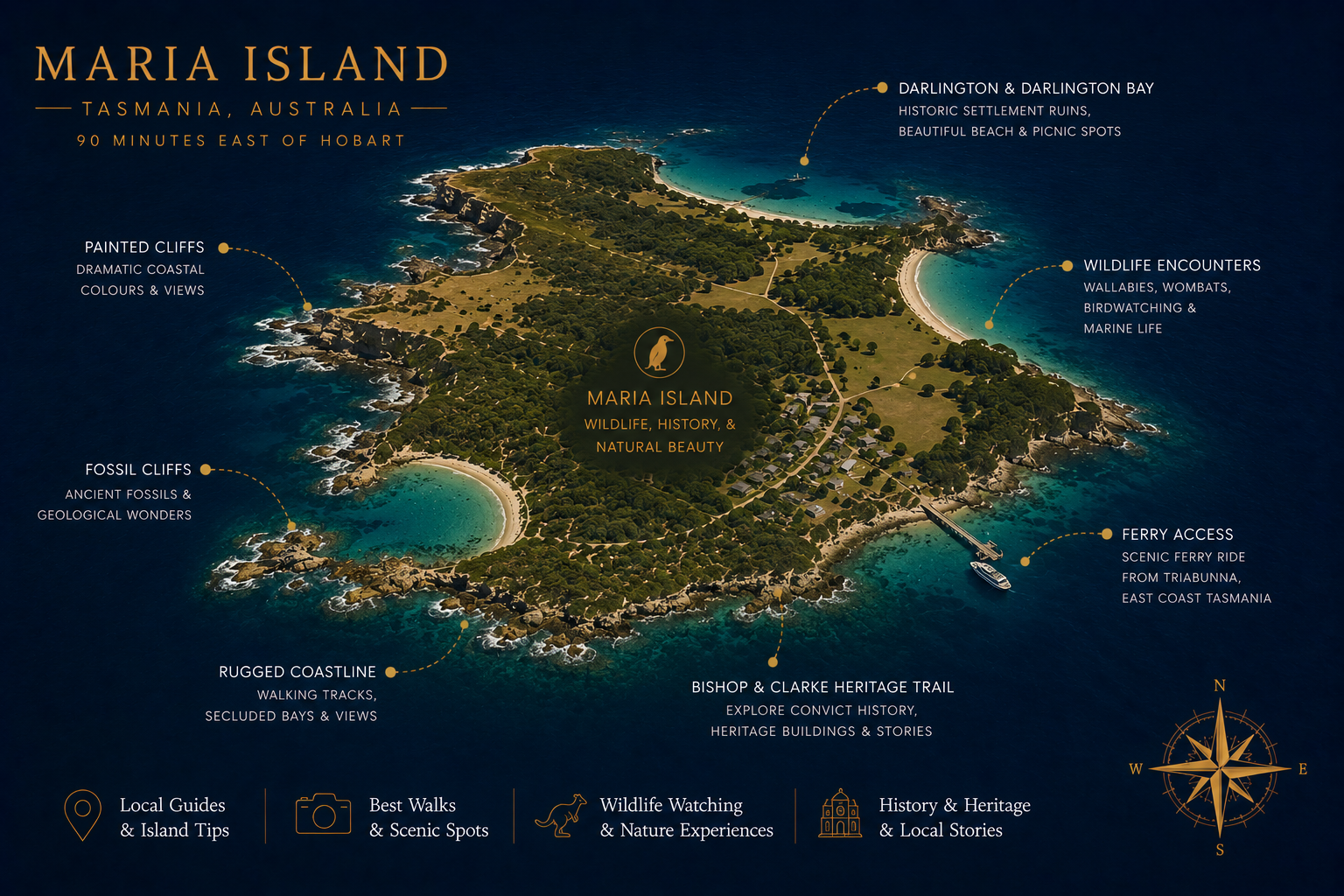
A national park you can only reach by boat, with no cars, no shops, no permanent residents, and a population of Tasmanian devils, wombats and Forester kangaroos that have learned humans aren't a threat. Maria (pronounced "ma-rye-a") feels like Tasmania with the modern bits stripped away. The convict ruins are the bonus.
- State
- Tasmania
- State capital
- Hobart (90 km southwest)
- Indigenous name
- wukaluwikiwayna
- Size
- 115 km², 20 km long
- Population
- None permanent (rangers only)
- Best time to visit
- Oct to April (warmer, longer days)
How to get there
Drive 90 minutes from Hobart to Triabunna on the east coast. The Maria Island Ferry runs the 30-minute crossing to Darlington, the only settlement on the island. Several departures daily in summer; reduced winter timetable.
The ferry is foot-passenger and cycle only. No vehicles are permitted on the island. Even the rangers use bicycles and the occasional ATV. Bring a bike on the ferry (small surcharge), hire one in Triabunna, or rely on your feet.
You can do Maria as a day trip and see Darlington, the Painted Cliffs and Bishop and Clerk lookout. To go further south (Riedle Bay, Haunted Bay), you need to camp or do the Maria Island Walk, a 4-day guided trek.
Approximate costs
| Item | Cost (AUD) |
|---|---|
| Ferry day return (adult) | $58 |
| Bike on ferry (one-way) | $10 |
| National park day pass | $24 / vehicle equivalent |
| Bike hire in Triabunna (per day) | $45 |
| Penitentiary (heritage units, per night, basic) | $50 to $65 pp |
| Campsite (per person, per night) | $13 |
| Maria Island Walk (4 days, all-inclusive) | $2,950 |
| Self-catered food (BYO) | Whatever you bring |
There are no shops on the island. Bring all food and water for the duration of your stay.
What to do
Painted Cliffs
The signature visual. Sandstone cliffs near the south of Darlington with mineral patterns swirled in iron oxide, yellows, reds, oranges in twisting bands across the rock. They're best at low tide; high tide covers them. About 90 minutes return walk from Darlington along the coast. Get the tide chart from the ranger station.
Fossil Cliffs
30 minutes north of Darlington, a different cliff formation entirely, limestone cliffs visibly packed with fossilised marine shells from the Permian period (~290 million years old). You can see the fossils with the naked eye in the rock face.
Bishop and Clerk
The big walk. 12 km return, climbs 600 metres to a basalt summit on the island's northern peak. The final scramble is exposed and not for everyone, but the view from the top, across the entire island, Mercury Passage, and back to mainland Tasmania, is one of the great Tasmanian outlooks. Allow 5-6 hours.
Darlington's convict ruins
Maria Island had two convict eras: a probation station from 1825-1832, and the larger Darlington probation station from 1842-1850. The remaining stone buildings, the Penitentiary (now bunkhouse accommodation), the Commissariat, the Coffee Palace, are part of the UNESCO Australian Convict Sites listing. You can wander freely.
Wildlife
Maria has been a sanctuary for translocated populations: Tasmanian devils were introduced in 2012 to maintain a disease-free insurance population (devil facial tumour disease has devastated mainland Tas populations). Forester kangaroos, wombats, Cape Barren geese and pademelons graze on the lawns around Darlington, it's not unusual to step out of your tent and have a wombat at eye level a metre away. They're habituated but please don't touch.
When to visit
October to April is the comfortable window, long daylight, walkable temperatures, the wildlife is most active. Summer (December to February) gives you the warmest seas and best swimming at Riedle Bay. Winter (June to August) is cold and rainy but the wildlife is still here and you'll often have a track entirely to yourself. Devil sightings improve at dusk year-round; in summer dusk is around 9pm, in winter around 5pm.
What to bring
- All food for your stay (no shops)
- Plenty of drinking water
- Layers, Tasmanian weather changes fast
- Waterproof / windproof jacket
- Hiking boots
- Day pack
- Headtorch (no street lights, dusk is when devils emerge)
- Camp stove if camping (no fires permitted)
- Cash for ferry tickets (card works most places)
- Tide chart for Painted Cliffs timing
A bit of history
The island is the country of the Tyreddeme band of the Oyster Bay nation, who knew it as wukaluwikiwayna. The Tyreddeme were among the populations devastated by the Black War of the 1820s and 30s.
European exploration began with Tasman in 1642, who named it after Maria van Diemen, wife of the Dutch East India Company governor. The first convict settlement was established at Darlington in 1825, described in records as the second-most isolated convict outpost after Macquarie Harbour, used for repeat offenders. After the first closure in 1832, the larger probation station ran from 1842 to 1850 with up to 600 convicts at a time.
After the convict era, the island had a chequered history: an attempted Italian colony in the 1880s by entrepreneur Diego Bernacchi (a failure), cement works in the early 20th century, sheep grazing, then a slow decline. Maria was declared a national park in 1972, and most of the introduced species removed. The Tasmanian devil insurance population was established in 2012; cheeky and successful.
Where this is on the map
Off Tasmania's east coast, 90 minutes from Hobart.
Other islands you might pair with this
The obvious Tasmanian pairing is Bruny Island, both reachable from Hobart, very different in feel. Kangaroo Island in SA gives you the bigger, drive-yourself version of a wildlife-rich island.